
The first BraveTechEU DefTech Forges in early June brought together 32 startups, SMEs, military end-users, technical experts and ecosystem partners in France and Estonia to test, refine and accelerate defence-relevant solutions under real operational constraints.

The first two BraveTechEU DefTech Forges took place in France and Estonia, marking the launch of a new hands-on format designed to help European defence innovators move from promising prototypes towards operationally relevant, testable solutions.
Across both locations, selected teams worked directly with European and Ukrainian end-users, technical experts, mentors and ecosystem partners. The objective was not only to present ideas, but to challenge assumptions, test solutions, receive practical feedback and define clearer next steps for further development.
Unlike traditional pitch events, the DefTech Forges focus on technologies at TRL 4 and above. This means that participating teams arrive with solutions that already have a working technical basis and can benefit from direct interaction with users, realistic constraints and structured iteration.
“Modern conflicts demonstrate that innovation cycles must become faster and closer to operational reality. Bringing together military users, startups, experts and industry partners helps shorten the distance between an idea and a capability that can address real defence challenges.”
Lieutenant Colonel Lauri Teppo
A format built around real feedback
The DefTech Forges build on the momentum of European defence innovation initiatives while moving beyond ideation. During the events, teams were exposed to operational perspectives, integration constraints and technical feedback that are difficult to access in standard innovation settings.
The 5-day programme gave participants time to work on their solutions, exchange with mentors and end-users, and refine their approach based on concrete feedback. For many teams, the value of the format was the ability to better understand how their technology could be used, tested and improved in a defence environment.

France and Estonia: two complementary environments
The first edition was implemented across two complementary European locations.
In France, the event focused on enhancing capabilities for ground operations, including UGVs. The competition was structured around three sub-challenges: UGV platform integration, communication and connectivity, and UGV countermeasures and threat mitigation. Sixteen EU-based and Ukrainian startups came on site to test a wide range of scenarios, including AI model training for UGV detection, UGV manoeuvres and mission autonomy for MEDEVAC/CASEVAC operations, or acoustic UGV detection nodes deployed along the frontline, among others. The activities took place at a unique European training facility: CENZUB, France’s National Urban Warfare Training Centre. This environment enabled teams to test their solutions in realistic urban conditions, while also offering access to forested areas and off-road terrain for more diverse operational scenarios.
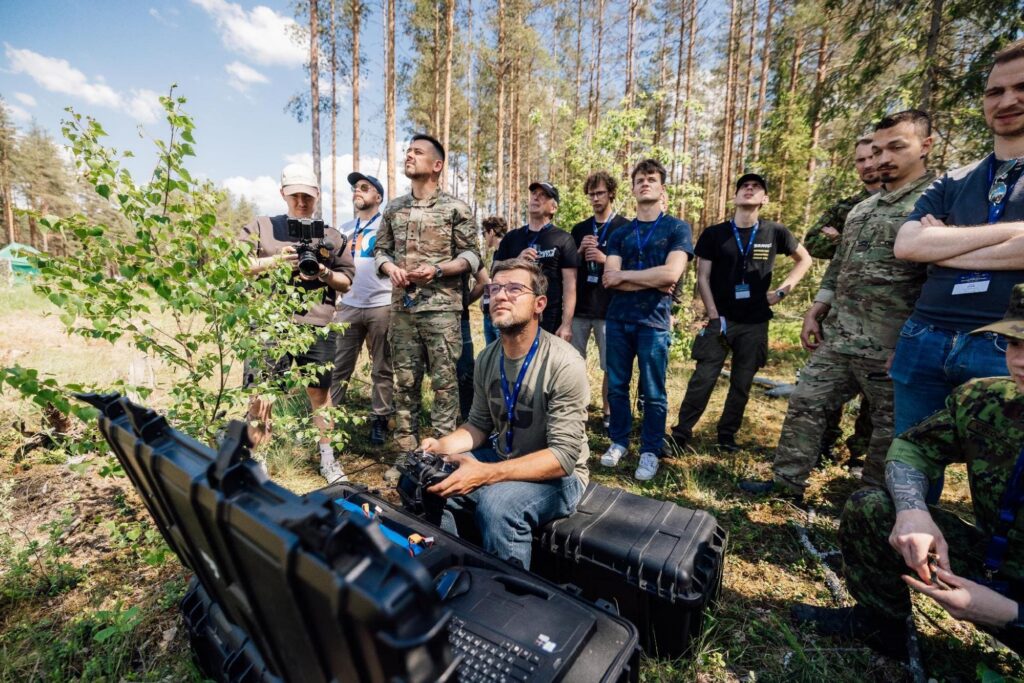
The Estonian DefTech Forge hosted 16 startups and SMEs developing technologies for contested environments, including autonomous navigation, EW resilience, counter-UAS capabilities, ISR systems and autonomous strike solutions. The programme focused on technologies designed to operate in GNSS-denied and electronically contested environments, while providing teams with direct feedback from military end-users, mentors and technical experts.
Together, the two locations demonstrated the European ambition behind the DefTech Forges: connecting innovators, end-users and ecosystem partners across borders, while keeping a shared focus on practical progress and operational relevance.


Inside the Forge: from challenge to iteration
Each Forge followed a structured journey. Teams were first introduced to the challenge context and the operational problems they were expected to address.
In France, the week began with a general briefing and a wargaming workshop designed to familiarise teams with operational constraints and prepare them for the testing scenarios. By Day 2, the teams were fully ready to begin three intensive days of field testing, with live demonstrations and team rotations across the different terrains. This format encouraged team cohesion and created strong synergies between participants, ultimately enabling the design and implementation of three end-to-end missions, which were conducted on the final day of testing. Midway through the testing phase, teams benefited from the support of a renowned French prototyping lab, which came on site to provide hardware troubleshooting, rapid prototyping assistance, and practical expertise to help improve the operational readiness of the solutions. At the end of Day 4, teams were given dedicated time to prepare their final presentations, followed by a networking cocktail with the French forces. On Day 5, the Demo Day brought together the 16 participating teams, who pitched their solutions in front of a selected seven-member jury representing European and Ukrainian defence institutions and industry. The morning concluded with an award ceremony, including the announcement of the winning teams and closing remarks from the organisers.


The programme combined operational briefings, one-to-one mentoring, technical reviews and direct interaction with end-users. Rather than focusing solely on pitches, teams worked iteratively throughout the week, validating assumptions, refining their solutions and adapting them to real operational requirements.
The final sessions allowed participants to present the progress achieved during the programme and define the next steps for further testing and experimentation.


Selected teams and winning solutions
The six selected teams will be announced shortly. They will enter the dedicated mentoring programme and begin preparing for Phase II: the Operational Experimentation Series, implemented by the European Defence Agency (EDA).
This next step will provide the teams with further opportunities to mature their solutions, access follow-on funding, and gain exposure to military end-users and defence stakeholders across Europe. Phase II is taking place in autumn 2026.
New Opportunities are coming up shortly
The BraveTechEU DefTech Forges will continue with new opportunities for local organisers and startups /SMEs across Europe.
The call for local organisers is currently open until mid-July. It will select the next implementing partners responsible for hosting the upcoming DefTech Forge editions (November 2026) and activating their local defence innovation ecosystems.
The next startup call for applications will open in late summer. An overview of the upcoming technology focus areas is already available on the BraveTechEU DefTech Forges website, allowing interested startups and SMEs to start assessing their fit ahead of the application phase. The next DefTech Forges are planned for November 2026, with the host locations to be announced shortly.
Stay tuned for further updates on the selected locations, application timeline and participation opportunities.